
What Size Dumpster Do I Need? A Flagstaff Sizing Guide
Renting too small means a second haul. Renting too big means paying for air. Here’s how to pick right the first time — and why our trailer dumpsters sit in your driveway without tearing it up.
- Driveway-safe trailers
- No permit for driveway placement
- Flat-rate quotes
- Delivery & pickup included
- Open 8 AM–6 PM, 7 days
The Two Sizes We Run
The small-project bin
Roughly 2–3 pickup truck loads. Fits in a single driveway space with room to park beside it. The right call for a bathroom remodel, a garage or attic declutter, a small deck tear-out, or a single-room cleanout.
The whole-project bin
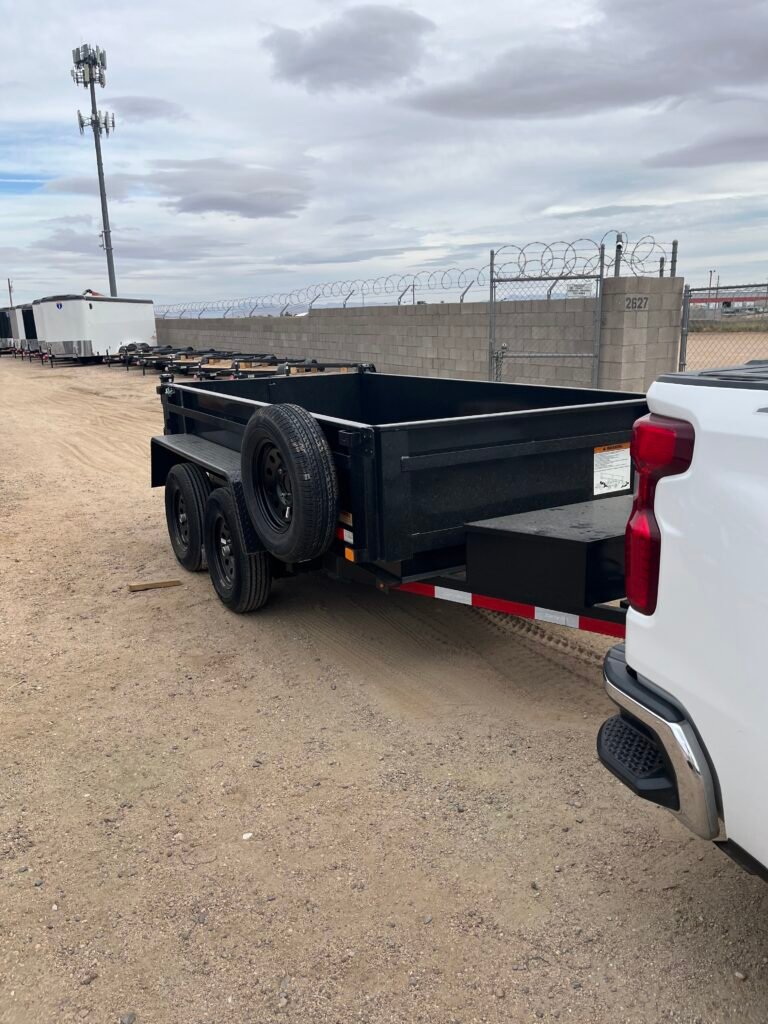
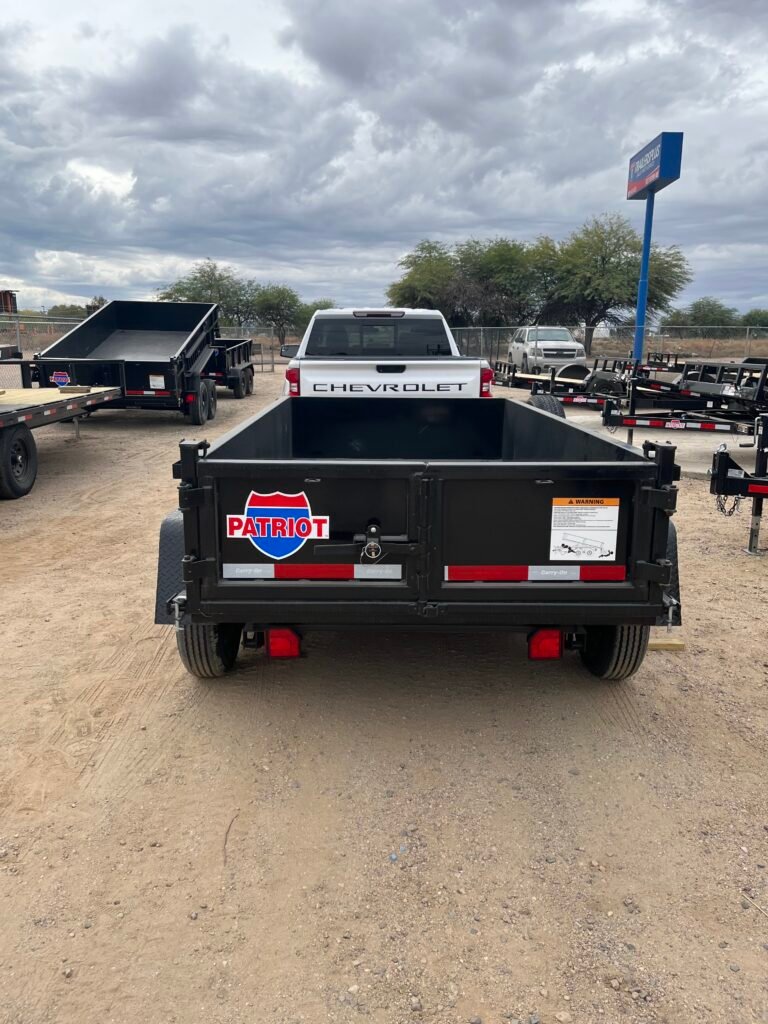
12′ long × 8′ wide × 4′ high — about 6 pickup truck loads. Handles a full home cleanout, a re-roof, a kitchen gut, a big yard-waste haul, or an estate clear-out. Most customers who hesitate between the two are happier with this one.
The honest rule: when you’re between sizes, go bigger. The price gap between our two sizes is smaller than the cost of a second delivery, and almost nobody finishes a project with less debris than they estimated. Demo work in particular expands — you open one wall and find two more things that have to go.
Match the Bin to the Job
Go with the 6-yard if you’re doing:
- A single bathroom remodel
- Garage or attic decluttering
- One room of flooring
- A small deck or fence tear-out
- Spring yard cleanup
- Moving-out purge from an apartment
- A shed demolition
- Historic or downtown properties with tight access
Go with the 15-yard if you’re doing:
- A full house or estate cleanout
- A roof replacement
- A kitchen gut and remodel
- Whole-home flooring or carpet
- Basement or crawlspace clear-out
- Large-scale yard and tree debris
- Multi-room furniture disposal
- Rental turnover on a full property
Why Ours Are Trailers, Not Roll-Offs
Most dumpster companies drop a steel roll-off box off the back of a truck. It works, but in Flagstaff it comes with real downsides that nobody mentions until the container is already on your property.
Your driveway survives
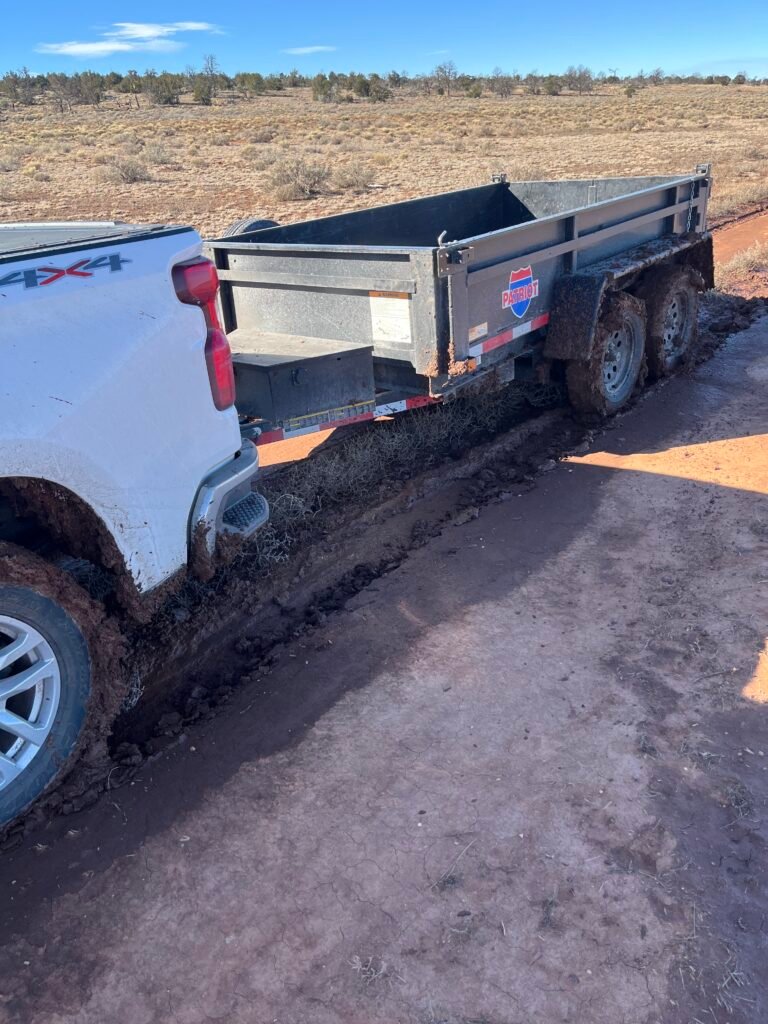
A roll-off gets dragged into place on steel rollers and skids. That’s how driveways get gouged and asphalt gets scarred. Our trailers roll in on tires and back out the same way.
Usually no street permit
Because a trailer dumpster fits in a standard driveway, most residential jobs never need public right-of-way placement — which means no city permit, no fee, no waiting on approval.
Tight access is fine
Narrow downtown lots, alley-access properties, cabins on unpaved drives. We can put a trailer where a roll-off truck physically can’t go.
Lower load height
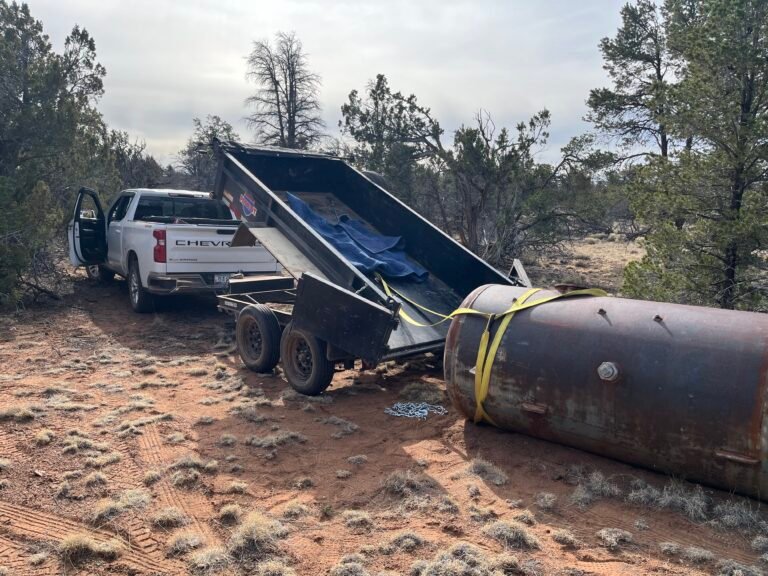
At four feet, the 15-yard walls are low enough to throw debris over instead of hauling everything up a ramp. That matters a lot by hour six of a demo day.
Snow and frozen ground
A loaded roll-off sitting on a frozen driveway through a freeze-thaw cycle is a problem. Trailers come and go without settling in.
Faster swaps
If you fill it and need another, we hook and go. No specialized roll-off truck has to be routed to you.
How to Estimate Your Load
- Count in pickup loadsPicture how many full pickup beds your debris would fill. Six or fewer, the 15-yard covers you. Two or three, the 6-yard will do.
- Add 25% for demo workIf you’re tearing anything out rather than just clearing it out, you’ll find more than you planned for. Every time.
- Think about weight, not just volumeRoofing shingles, concrete, tile, dirt, and wet yard waste are heavy for their size. A bin can hit its weight limit while still looking half empty.
- Or just call usDescribe the project in a sentence and we’ll tell you which one you need. We’ve done this enough that we’re usually right, and we have no reason to upsell you into a second delivery.
Where We Deliver
We drop dumpsters in Flagstaff, Sedona, Village of Oak Creek, Williams, Doney Park, Parks, Kachina Village, Bellemont, and Munds Park. See all areas we serve.
Questions People Ask
What size dumpster do I need for a roof replacement?
The 15-yard for almost any residential re-roof. Shingles are dense and heavy, so a roof job fills a bin faster by weight than by volume — a typical single-layer tear-off on a 2,000 sq ft home will use most of a 15-yard. Tell us the square footage and how many layers are coming off and we’ll confirm.
What size do I need for a whole-house cleanout?
The 15-yard, and for a fully furnished home you may need a swap. Furniture is bulky and doesn’t compact well. If you’re clearing an estate, our full-service estate cleanout is often cheaper than a dumpster plus your own labor — worth comparing before you book.
Can a dumpster sit on my driveway without damaging it?
Ours can. Trailer dumpsters roll in on tires rather than being skidded into place, which is what damages driveways with traditional roll-offs. We also place boards under the tongue and jack points on request. If you have stamped concrete or fresh asphalt, tell us and we’ll take extra precautions.
Do I need a permit to have a dumpster delivered?
Not for driveway or private-property placement, which covers the large majority of our residential jobs. If the only workable spot is the public street, the City of Flagstaff requires a right-of-way permit — call us and we’ll walk you through whether you actually need one. Most people don’t.
How much space do I need for delivery?
For the 15-yard, plan on roughly 25 feet of length and 10 feet of width to allow for the trailer plus the truck maneuvering in and out, with clear overhead access (watch for low branches and power lines). The 6-yard needs considerably less. We’ll confirm when you book.
What if I fill it and still have more?
Call and we’ll swap it. We pull the full one and drop an empty, usually same or next day. You only pay for the additional haul, not a new rental setup.
What Size Dumpster Do I Need for My Project?
Still asking what size dumpster do I need? Call us with a quick description or a few photos and we’ll match the right trailer to the job, so you’re not paying for space you won’t use or making a second trip. For items that shouldn’t go in a dumpster, see Coconino County’s recycling guide.
What Size Dumpster Do I Need? Start With Simple Math
Dumpster sizes are measured in cubic yards. A cubic yard is a cube 3 feet long, 3 feet wide and 3 feet tall, which works out to 27 cubic feet. If you can measure a pile with a tape measure, you can estimate how many yards of debris you have.
Here is the method:
- Pile up (or picture) everything that is going.
- Measure the length, width and height of the pile in feet.
- Multiply the three numbers to get cubic feet.
- Divide by 27 to get cubic yards.
For example, a pile in the garage that is 10 feet long, 6 feet wide and 3 feet high is 180 cubic feet. Divide by 27 and you get about 6.7 cubic yards. That is right at the edge of a 6-yard trailer, so it is a good candidate for sizing up, especially once you account for bulky items that do not stack flat.
Loose piles also take up more space than you would think. A recliner, a box spring or a pile of branches has a lot of air in it. Breaking things down before loading helps, but when you are estimating, round up.
The pickup-truck shortcut
If measuring sounds like a hassle, count truck loads instead. Our 6-yard holds roughly 2 to 3 pickup truck loads, and our 15-yard holds about 6. Think about how many trips it would take to haul everything in a full-size pickup, then add 25% if you are doing demolition, because demo almost always produces more than people expect.
What Size Dumpster Do I Need for My Project?
Every job is different, but these project notes will get you close to answering “What size dumpster do I need?” for your specific job. The rest of this page covers the sizes we carry: a 6-yard and a 15-yard dump trailer.
Garage cleanout
A typical one-car garage full of boxes, old shelving, bikes and odds and ends often fits in the 6-yard. A packed two- or three-car garage, or one with old furniture, workbenches and years of storage, usually calls for the 15-yard. Before you load, pull out scrap metal, usable tools and anything you can donate. That frees up space for the stuff that truly has to go.
Kitchen remodel
A full kitchen gut produces cabinets, countertops, drywall, flooring and sometimes appliances. That adds up fast, which is why a kitchen gut is a 15-yard job. Stone or tile countertops and tile floors are heavy, so mention them when you call.
If your home was built before 1978, plan for lead paint. The EPA’s guide to lead-safe renovations for DIYers recommends assuming lead-based paint is present in older homes, and sealing debris in heavy plastic before it leaves the work area. Older flooring, ceiling tile and pipe wrap can also contain asbestos. The EPA advises having suspect materials tested before a remodel disturbs them, since you cannot tell by looking.
Roof tear-off
Roofing is where weight matters more than size. Asphalt shingles are dense, and a tear-off can include multiple layers, underlayment, nails and some damaged decking. A trailer of shingles can reach its weight limit well before it looks full.
Roofers measure in squares, where one square is 100 square feet of roof. Know how many squares you are tearing off and how many layers are on the roof, and tell us both when you call. For most residential re-roofs, the 15-yard is the right call. A very large roof or one with several layers may need a swap partway through.
Yard cleanup
Branches, brush, pine needles and old landscaping are bulky but usually not very heavy when dry. A spring yard cleanup often fits in the 6-yard. Large tree debris or a full property cleanup is a 15-yard job. Wet yard waste is heavier, and dirt, sod and rock are very heavy, so treat those like construction debris and keep them separate when you can.
Estate cleanout
Clearing out a whole house, especially one that has been lived in for decades, is almost always a 15-yard project. A furnished home may need a swap. Estate cleanouts also turn up a lot of items that should not go in a trailer at all, like paint, chemicals, old electronics and appliances with refrigerant. Set those aside as you go. If the family would rather not do the lifting, our estate cleanout service may be a better fit than a rental.
Moving out
Moving is a good time to get rid of what you do not want to pack. An apartment move-out or a small purge often fits the 6-yard. Clearing out a whole house before a move, with furniture, mattresses and garage contents, is usually 15-yard territory. Just remember that mattresses are a restricted item, so ask about them before they go in.
Weight vs. Volume: Why Both Matter
Size tells you how much space you have. Weight tells you how much the trailer can safely carry and how much it will cost to dispose of. These are two separate limits, and you can hit either one first.
Household junk is mostly air. Furniture, boxes, toys and clothing fill a trailer long before they get heavy. Construction debris is the opposite. Concrete, brick, tile, dirt and shingles pack tightly with almost no air between pieces, so they get heavy long before the trailer looks full. Heavy materials can hit weight limits at half full.
That is why the honest answer to “What size dumpster do I need?” sometimes is not about size at all. If your project is mostly concrete or dirt, the question becomes how much weight you are moving, and the answer might be a smaller load or more than one haul.
Heavy materials to flag when you call
- Concrete and brick: Old patios, walkways, steps and block walls.
- Dirt, sod and rock: Landscaping and grading projects.
- Roofing shingles: Especially multi-layer tear-offs.
- Tile and stone: Floors, showers and countertops.
- Plaster: Common in older homes and much heavier than modern drywall.
- Wet debris: Rain or snow soaking drywall, carpet or yard waste.
Heavy debris is also hard on your body. OSHA’s heavy lifting guidance suggests keeping manual lifts to about 50 pounds, using two people for anything heavier and turning with your feet instead of twisting your back. Break concrete into manageable pieces and use a wheelbarrow or hand truck where you can.
Keep reusable materials out of the load
The less you throw away, the smaller the dumpster you may need. The EPA’s guidance on construction and demolition materials recommends salvaging doors, hardware, fixtures and appliances, and notes that concrete and brick can be reused as fill or driveway bedding. Pulling those items out before you load can be the difference between one trailer and two.
Placement and Driveway Space
Answering “What size dumpster do I need?” also means picking a spot. Our 15-yard needs roughly 25 feet by 10 feet of space with overhead clearance, and the 6-yard needs less. Before delivery, walk the spot and check:
- Overhead: Low branches, power lines, eaves and basketball hoops.
- Access: A clear path in and out, with vehicles moved out of the way.
- Surface: Fairly level ground. Let us know if you want driveway boards.
- Loading: Easy access from the house or work area, so you are not hauling debris across the whole yard.
- Snow: In winter, plow or shovel the spot and a path to it ahead of time.
If the trailer has to go in the street instead of on your property, the City of Flagstaff may require a Parking and Right-of-Way Encroachment Permit from its Engineering Division. That permit covers temporary items in the right-of-way, including solid waste bins and storage containers.
What Happens If You Pick the Wrong Size
Too small
This is the more common mistake when people guess the answer to “What size dumpster do I need?” instead of measuring. You run out of room partway through, work stops, and you need a swap or a second haul. That costs time and money, and debris piled next to a full trailer is not going anywhere until it is loaded. Overfilling is not an option either. Loads have to be level with the top rail so they can be towed safely.
Too big
Renting more space than you need means paying for empty room and giving up more of your driveway. It is a smaller problem than running out, which is why we say: when in doubt, go bigger. Even so, a quick conversation about your project usually gets you the right size the first time.
A note on general industry sizes
You will see other sizes advertised in general, such as 10, 20, 30 and 40-yard roll-off containers. Those are common industry sizes, not AZ Haul’s offering. Roll-offs are large steel boxes dragged on and off a truck, and the bigger ones are built for commercial jobs. Our 6-yard and 15-yard dump trailers cover the residential projects most Flagstaff-area homeowners take on.
More “What Size Dumpster Do I Need” FAQs
What size dumpster do I need for a bathroom remodel?
A single bathroom remodel usually fits in the 6-yard. If you are tearing out a tiled shower, tile floors or a cast iron tub, let us know, because those add a lot of weight.
What size dumpster do I need for a deck or fence removal?
A small deck or fence tear-out often fits the 6-yard. A large, multi-level deck or a long run of fencing may need the 15-yard. Concrete footings add weight, so mention them.
What size dumpster do I need for a basement or crawlspace?
Basement and crawlspace clear-outs are usually 15-yard jobs, especially if there is old furniture, storage or water-damaged material. Wet carpet and drywall are heavier than they look.
Can I put dirt or concrete in the same trailer as household junk?
Ask first. Heavy materials change how a load is priced and can hit weight limits quickly. Keeping them separate, or loading them in a planned amount, avoids surprises.
How do I know if my pile will fit?
Measure it, multiply length by width by height, and divide by 27 to get cubic yards. Or count pickup truck loads. If you are close to the line, size up, or send us a description of the project and we will help you decide.
What if I am still not sure what size dumpster I need?
Call us. Tell us the project, the rough amount of debris and whether anything heavy is involved, and we will recommend a size. It takes a few minutes and saves you from a second haul.
What items can’t go in the trailer no matter the size?
Appliances with refrigerant, tires, mattresses and paint are restricted. City of Flagstaff and Coconino County residents can take paint, chemicals and many electronics to the City’s free Hazardous Products Center, within its quantity limits.
Get the Right Size the First Time
AZ Haul is a veteran-owned, locally owned company based in Bellemont, with a shop at 2001 E Huntington Dr in Flagstaff. We serve Flagstaff, Sedona, Williams, the Verde Valley and nearby communities, 8 AM to 6 PM, seven days a week. If you are still asking yourself “What size dumpster do I need?”, call (928) 600-2035 and we will help you pick the right trailer for the job.
Not Sure? Just Describe the Project
One phone call and we’ll tell you which bin you need. Flat-rate quote, delivery and pickup included, no upsell.
More on rentals: rental cost & how long you can keep it · what can and can’t go in · contractor accounts · dumpster rental overview